
Alphabear Review
There is a special place in my heart for word games. I am one of those people still playing Wordle, and I pair it up with Spelling Bee, Connections, and the whole bivvy of word games that live on the New York Times word game section.
That I’d be delighted by Alphabear is more or less a given. It’s got words. It’s got bears. It’s basically bear-themed Boggle. I enjoy it very much.
That said, I do - as always - have more thoughts on it than just “bears good.”
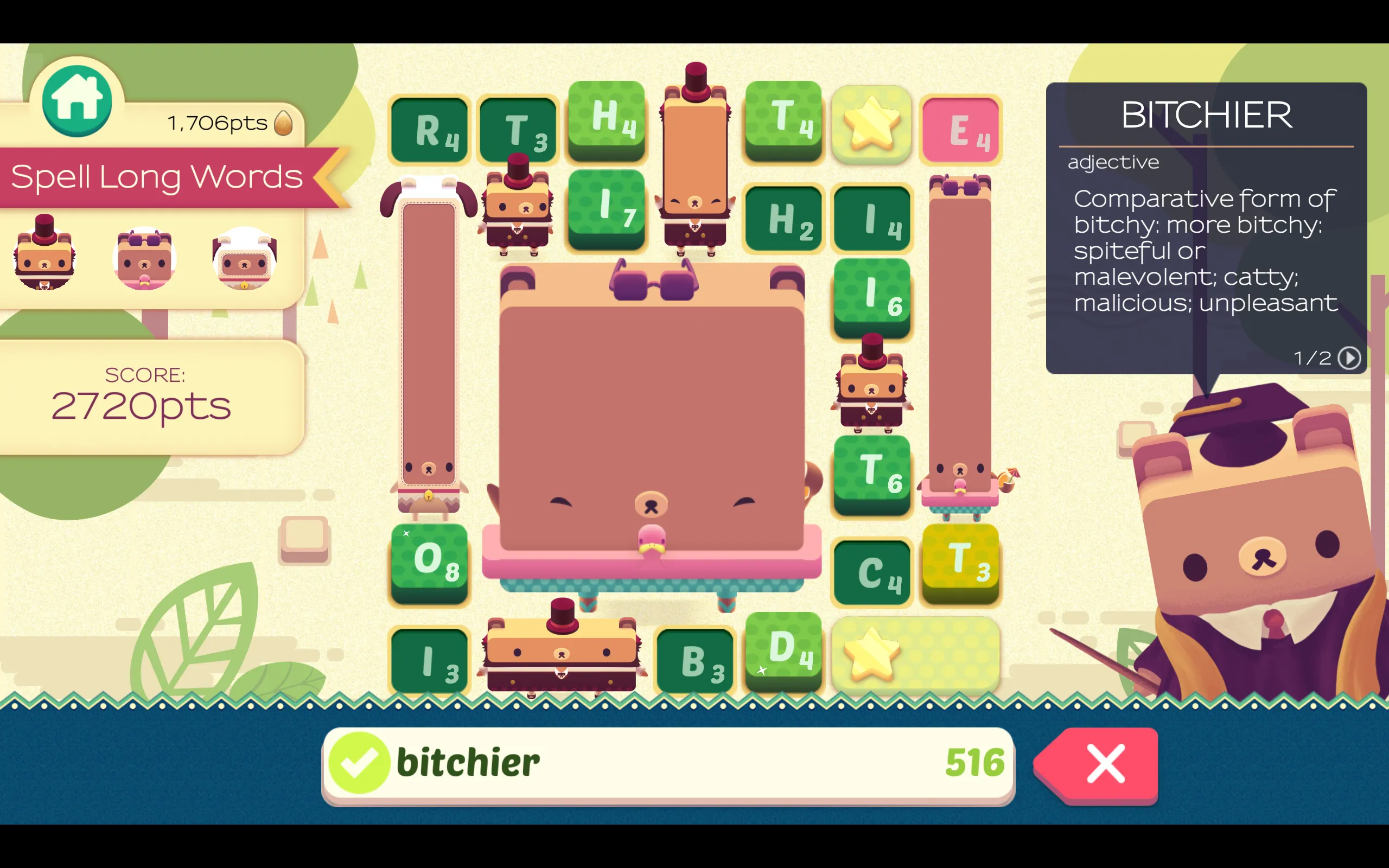 (adj) What I could make this review, if I really wanted to
Alphabear is a word puzzle game. Presented with an unfurling grid of letters, the game challenges players to make words with the letters available to them. Each letter becomes a bear, with adjacent bears coalescing into larger and larger bears that are worth more points at the end of the round. Each letter also has a timer, which, when it ticks to zero, turns the letter into a stone block, preventing the growth of nearby bears. Through the combination of bear growth and the block timers, the game becomes a puzzle, not only of making words, but of using letters that will ultimately prevent timers from ticking down and fill the entire grid with bears.
There is a lot about these mechanics that works. The idea of finding words in a jumble of letters is a tried and true formula, but is also one that has been played out in a large variety of forms already. Making each letter single use and adding a timer adds a more strategic dimension to the puzzle that is a welcome change of pace. Rather than having a grand old time making monstrously long words, I thought more strategically about what I wanted to make, and why I did have to use that x with one turn left on it, actually. The inclusion of these mechanics forces the player to stretch beyond the familiar words they’re used to in these types of games, and instead, reach for more esoteric and exotic ways to make their bears grow and grow.
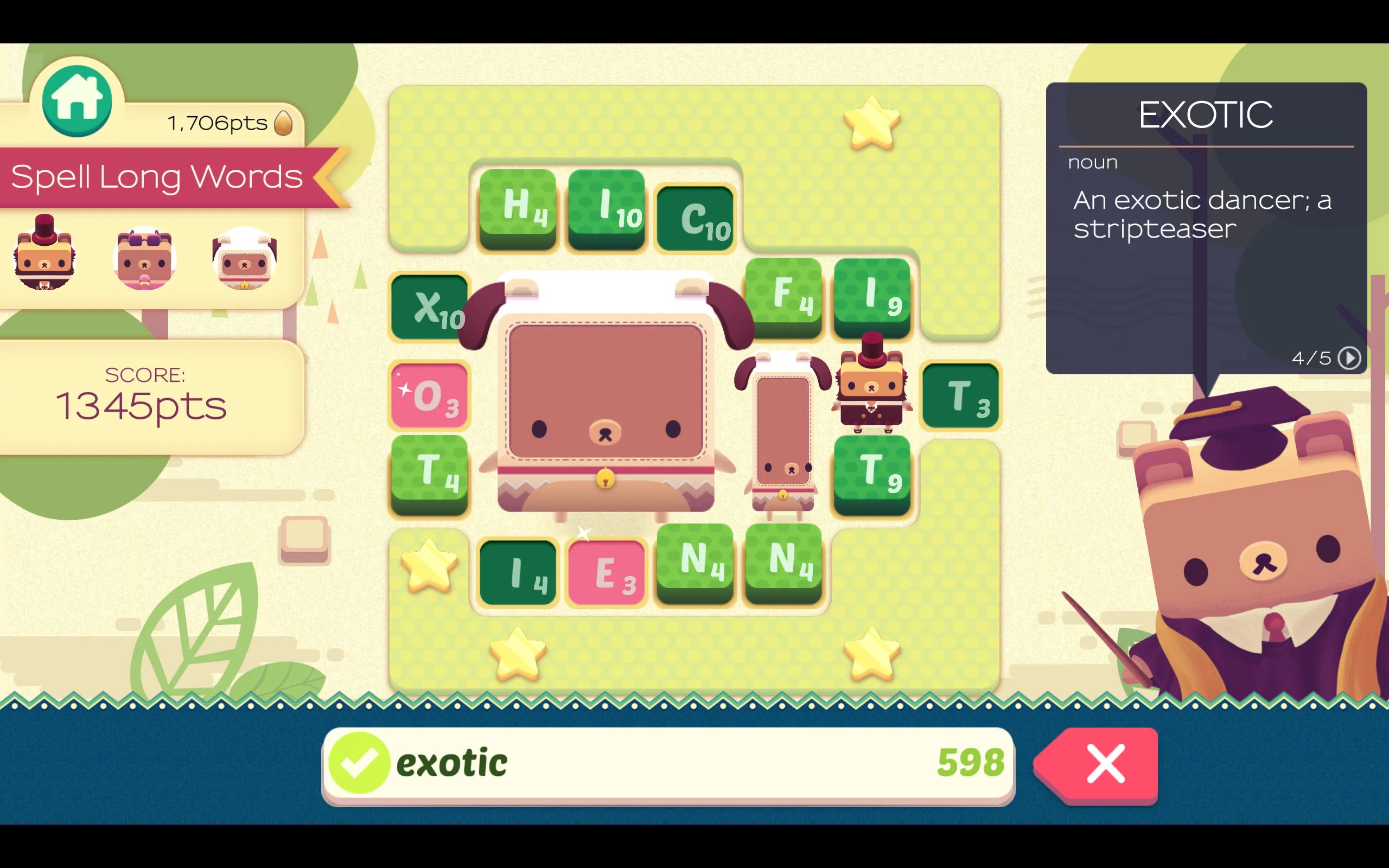 (adj) Hey, would you look at that wild coincidence
However, the letters and ability to make words are not the sole selling point of this game. Alphabear is fundamentally a cosy bear-themed game, and the cute bears are an undeniable highlight of the game. In addition to having a score, each level also allows players to unlock bears with a variety of bonuses (important) and fun costumes (more important). While getting ten thousand points in a round may be a goal either I or the game could set for myself, the goal of getting a pirate bear or a robot bear is an even better one.
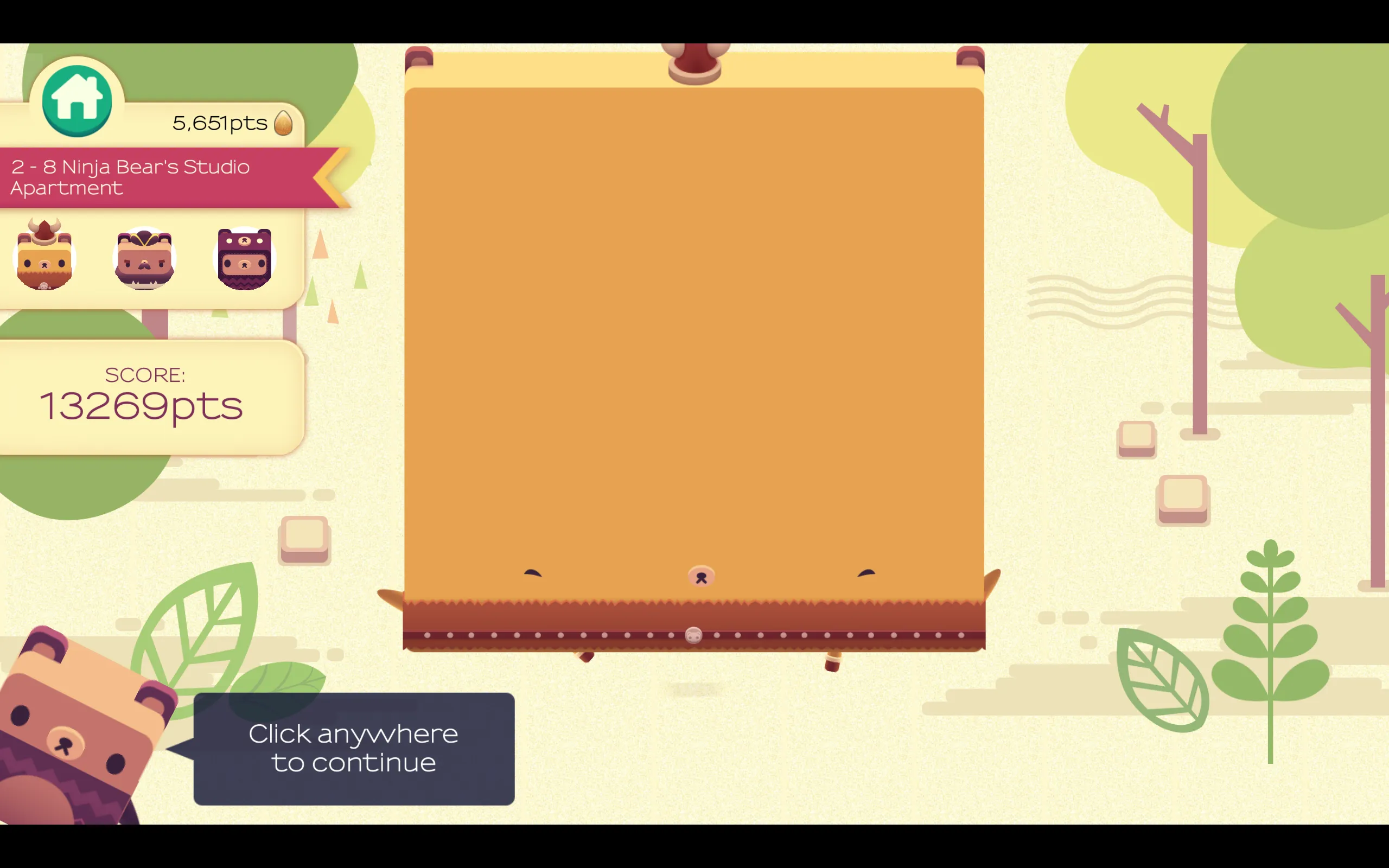 I am not convinced that bear fits in a studio apartment.
That said, Alphabear is not without its flaws. For all its word-making and bear-themed fun, the underlying mechanics can be frustrating. Each bear provides a particular set of bonuses; however, which bear a player gets after completing a level is somewhat random. This means that bonuses that may be helpful for clearing the next level may or may not be unlocked, leading to needing to replay previous levels just to get the bear that will nudge a score up to where it needs to be.
This could, on the one hand, be deeply frustrating, and were this most other games, I would argue that it would be. However, Alphabear’s levels are all more or less the same. While the initial distribution of letters and the number of rocks or limitations on the level vary, the fundamental concept of the game stays the same from level to level. Regardless of the hurdles, I am going to look at my field of letters and make words with them, and I will do this over and over and over. That I have to repeat a level to unlock a bear isn’t necessarily a problem when the level I’m ultimately unlocking looks more or less the same as the one I’m playing - the only difference is in my own sense of progression, which is already minimal in a game where all the levels look and feel more or less the same.
More annoying is the game’s points system. While many word games provide bonuses for making longer words, Alphabear in general does not, creating an incentive to pepper the board with small words rather than taking the time to craft a thirteen letter behemoth. This, on the one hand, fits in well with the game’s gentle nudging towards using letters and approaches players might not usually use, but also becomes frustrating when trying to play as efficiently as possible. The more letters used in a word, after all, the more efficiently and safely the bears grow, with minimal risk of letters timing out. It feels odd, then, that trying to grow safely doesn’t have a corresponding rise in points.
But then I make a really big bear and some happy music plays, and you know what, it doesn’t matter. The bears are big. The bears are happy. I’m happy.
I word good.
Developer: Spry Fox
Genre: Puzzle
Year: 2017
Country: United States
Language: English
Play Time: 17 hours
Playthrough: https://youtu.be/KwDfyptnvB8