
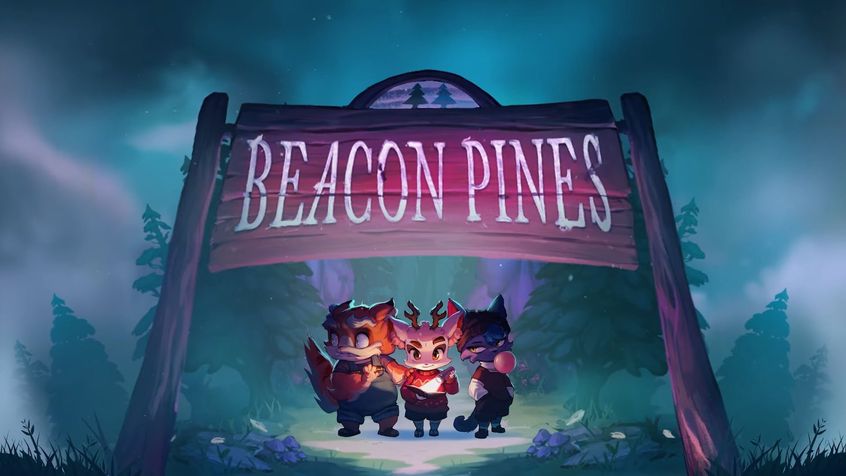
Beacon Pines Review
I think, to a certain extent, all of us assign some degree of mystery to our childhood hometowns. The forest beside the house is not just a forest, but a gateway to some mysterious alternate dimension. The weird pond that you tried to sail across on a door you found isn’t just a weird pond. The neighbourhood beside yours is not just the edge of your neighbourhood, but some faroff mystical place that, when you get there, is infinitely far away. There’s something genuinely sweet, then, about not only exploring that idea of a child’s view of their hometown, but of having the payoff of there actually being something going on in that town.
Beacon Pines is a narrative adventure game. You play as Luka, a boy who recently lost his parents, and finds solace in exploring the mysteries of the town of Beacon Pines beside his friend, Rolo. The two boys go on a range of adventures - both real and imaginary - eventually stumbling into a grand conspiracy that envelopes the town.
As with any narrative game, Beacon Pines is heavily reliant on its story to carry the weight. Beacon Pines’ story is excellent, with twists, turns, and tension in all the right places, while also not losing sight of its protagonist’s viewpoint. This is fundamentally a story about a child told through a child’s perspective, and Beacon Pines does an excellent job keeping that in mind, even while tackling complex topics.
What makes Beacon Pines unique and memorable, however, is the mechanic through which it tells its story. It’s one thing to tell a story. It’s another to truly explore it.
 The answer is always "tickles."
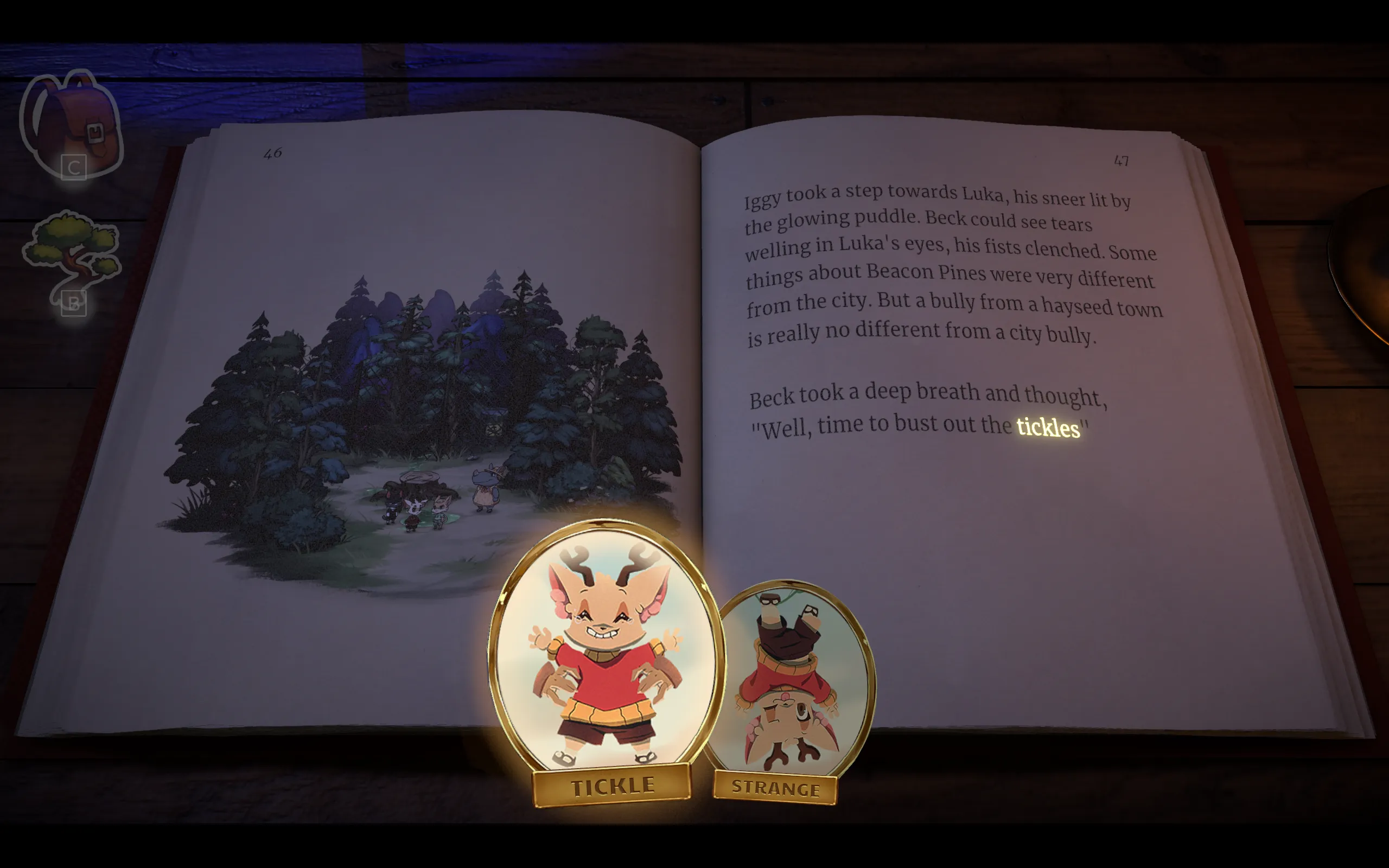
Rather than telling its story in a straightforward style, Beacon Pines instead presents itself as a choose-your-own adventure story. At certain points in the story, the player makes a decision about how to approach a given conflict, with the options available to them being drawn from their past experiences. This approach allows the player to explore a variety of paths the narrative could take, but also, gain experiences that then allow them to replay past decisions. It’s a recursive, cyclical sort of story telling that brilliantly reflects the story it’s telling.
While this does mean that player choice is essentially an illusion, that it’s an illusion isn’t necessarily a problem. The semblance of choice does enough to propel the player forward and make them feel like they’re influencing the story, even though the story is very much already written.
 Hey! I'm very aware of being a dumbass putting myself in danger!
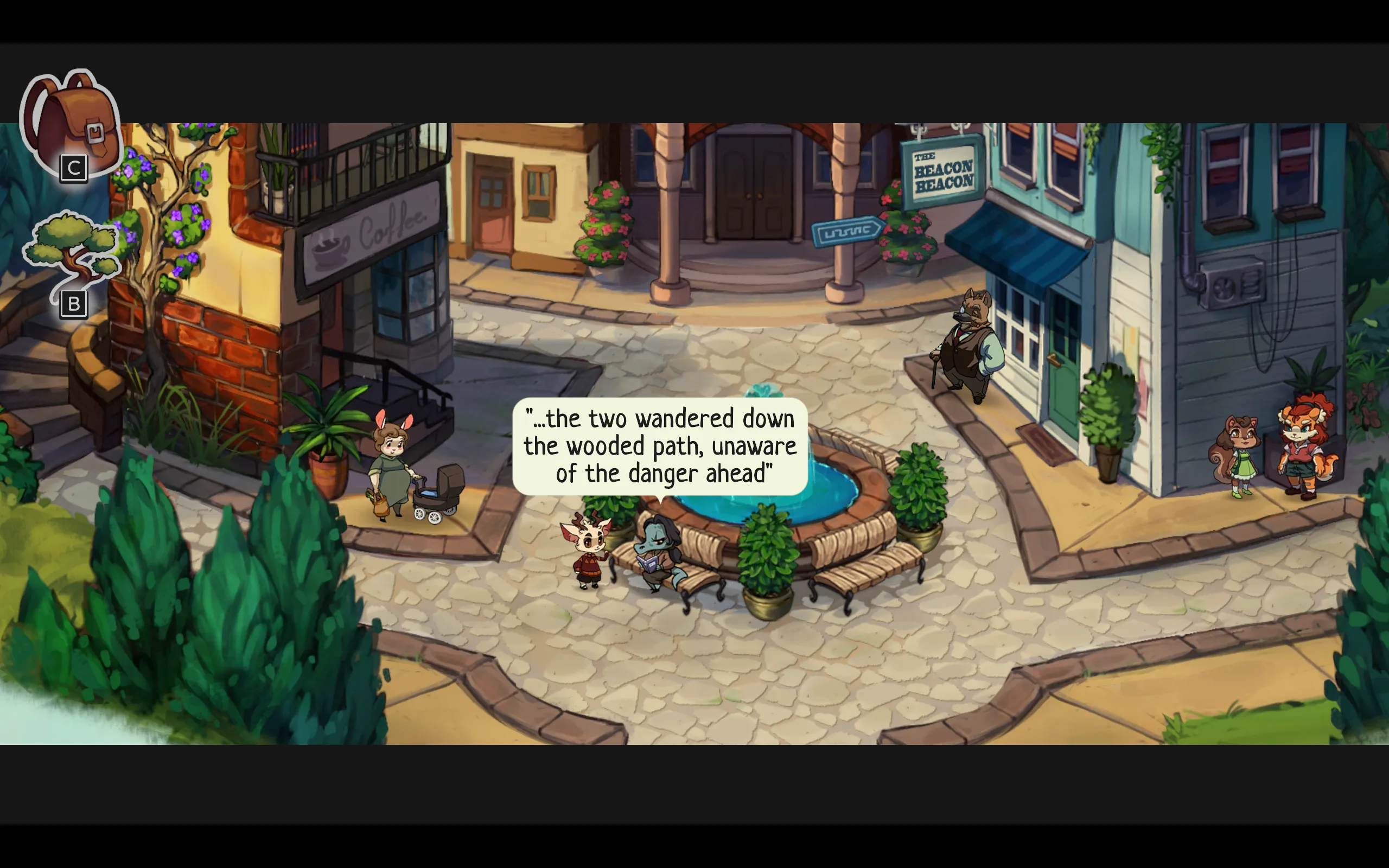
In many ways, this sense of being in control while not actually being in control makes Beacon Pines a lovely analogy for childhood itself. While the plots Luka and his friends uncover are very real, that they are explored through a child’s eye and with adorable child characters makes them feel a bit cozier than they otherwise would. Throughout the game, I was drawn in, not just by the prospect of uncovering the plot, but by wanting to see what Luka would do with the plot, how he and his friends would react, and what everything meant to them. It was delightful and sweet, and in many ways, captured what it means to be a child exploring the world and its nuances for the first time.
Developer: Hiding Spot
Genre: Adventure
Year: 2022
Country: United States
Language: English
Time to complete: 5-6 hours
Playthrough: https://youtu.be/YCEwS07jcgc