
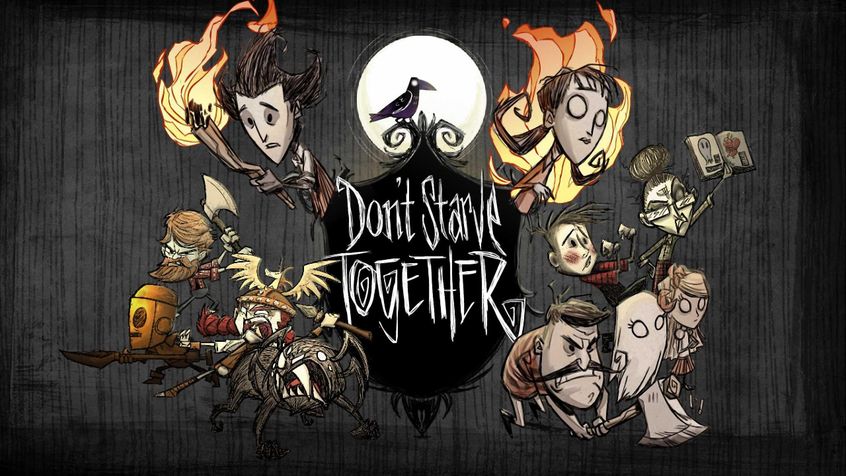
Don't Starve Together Review
This is not a review of Don’t Starve Together. I need to get that out of the way right away. This is not and there never will be a review of Don’t Starve Together because, even though I have six hours or so of this game under my belt, I’ve never played it for more than an hour or so at a time. I’ve tried, don’t worry. My rule for writing a review is that I have to have a minimum of two hours in a game, but I can’t do it for this game. I just can’t get that far into it. It’s not the game’s fault, not really. It’s mine. And it’s the fault of the people I play with. Or one, anyway.
It’s not a secret that I dislike survival crafting games. While they’re not my least favourite, and while I can certainly enjoy some survival crafting elements, it’s not a game I enjoy. Struggling to get through Don’t Starve Together enough to give it an honest review, I thought about why. What is it about this genre of game that I dislike so much? What is it about the innocent act of gathering resources and building something that I just can’t stand. Mulling it over as I got pummelled by a frog for a fourth time that hour, I got a hint of an answer, something creeping into my mind as I stammered through my microphone, asking for help and getting the response “You died again?”
Ladies and gentlemen, meet Jeff.

I love Jeff. We love Jeff. He’s a frequent friend of the review series, and one of my dearest friends. Jeff is great, and nothing in this post is a slight on anything about Jeff. Playing games with Jeff is one of the highlights of my week, and I look forward to it every single time.
This man is much better at survival crafting than I am. He plays a lot of survival crafting game. He enjoys them, and I’m happy for him. We all need something that brings us joy, and if survival crafting games do that for him, I wish him nothing but love with them.
There is, however, a consequence to Jeff being much better at survival crafting games than I am. For any given game we load up together, Jeff will have a better understanding of what to do and how to approach the game than I will. The tropes of the genre are more innate, the buttons more known, everything more familiar in a way that’s not true for me.
There’s nothing wrong with this, of course. When we load up deckbuilders, I thrash him every time because I have more experience and a better understanding of the genre. The consequence, though, is that, when playing a co-operative game, there’s a knowledge gap. There’s a gap between what I think I ought to be doing, what I actually ought to be doing, and whatever Jeff is doing. While I’m still flipping through menus, trying to figure out how to get the resources to make a shovel, Jeff’s built a research station and a crockpot. While I’m getting chased around the map by bees that I tried to set on fire, Jeff’s going mano e mano against a boss using the rapier he magically acquired.
There’s a gap, and in that gap, there’s a sense of frustration, of knowing I’m not playing the game correctly, and that everyone knows it.
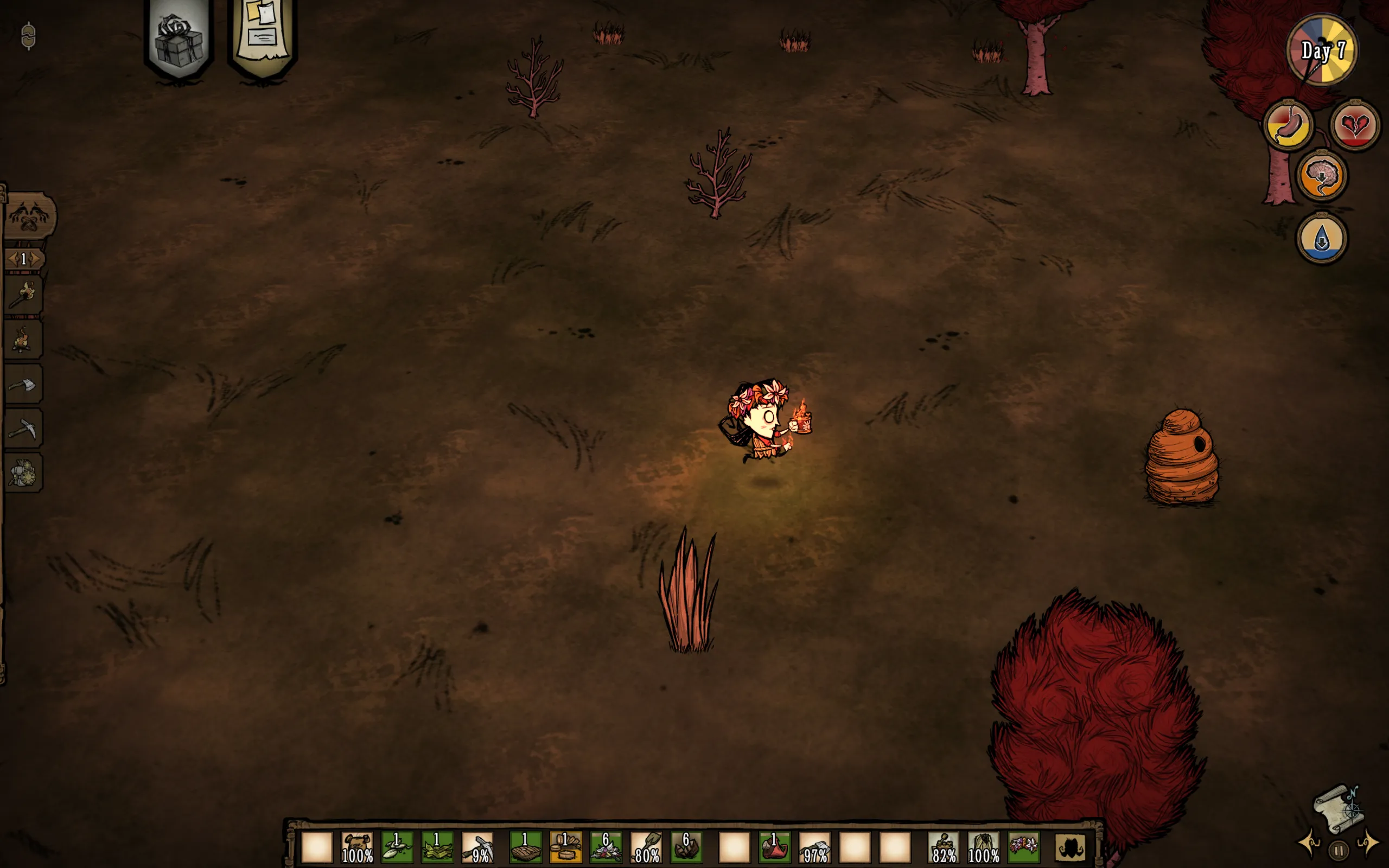 You thought I was kidding about the bees.
In some genres, this experiential gap is fine. When playing platformers, for instance, I’m also miserable. Ultimate Chicken Horse has become a favourite game in my friends group specifically because I’m so miserable at it. The difference, though, is that, while I’m aware I’m bad at the game I’m playing, there’s no sense that I am being left behind, or worse, am actively harming my fellow players through being bad at the game. If I fall in a pit and die two seconds into a level, it’s no loss to everyone else. If anything, it was exactly what I was supposed to do. When I am watching Jeff kit up in fancy gear while I stand there with a pickaxe and an inventory full of berries, though, I’m left with the feeling that, in a game meant for a team, I am being carried and humoured, not part of a team, but just someone sent to tag along.
The solution, of course, is to get better at the game, to take the time to play more than hour at a time so I can keep up with the rest of the group. It’s to learn the tropes of the genre, learn the strategies, and get better at survival crafting games. If I want to be a member of the team, I have to earn it, and that’s earned through skill.
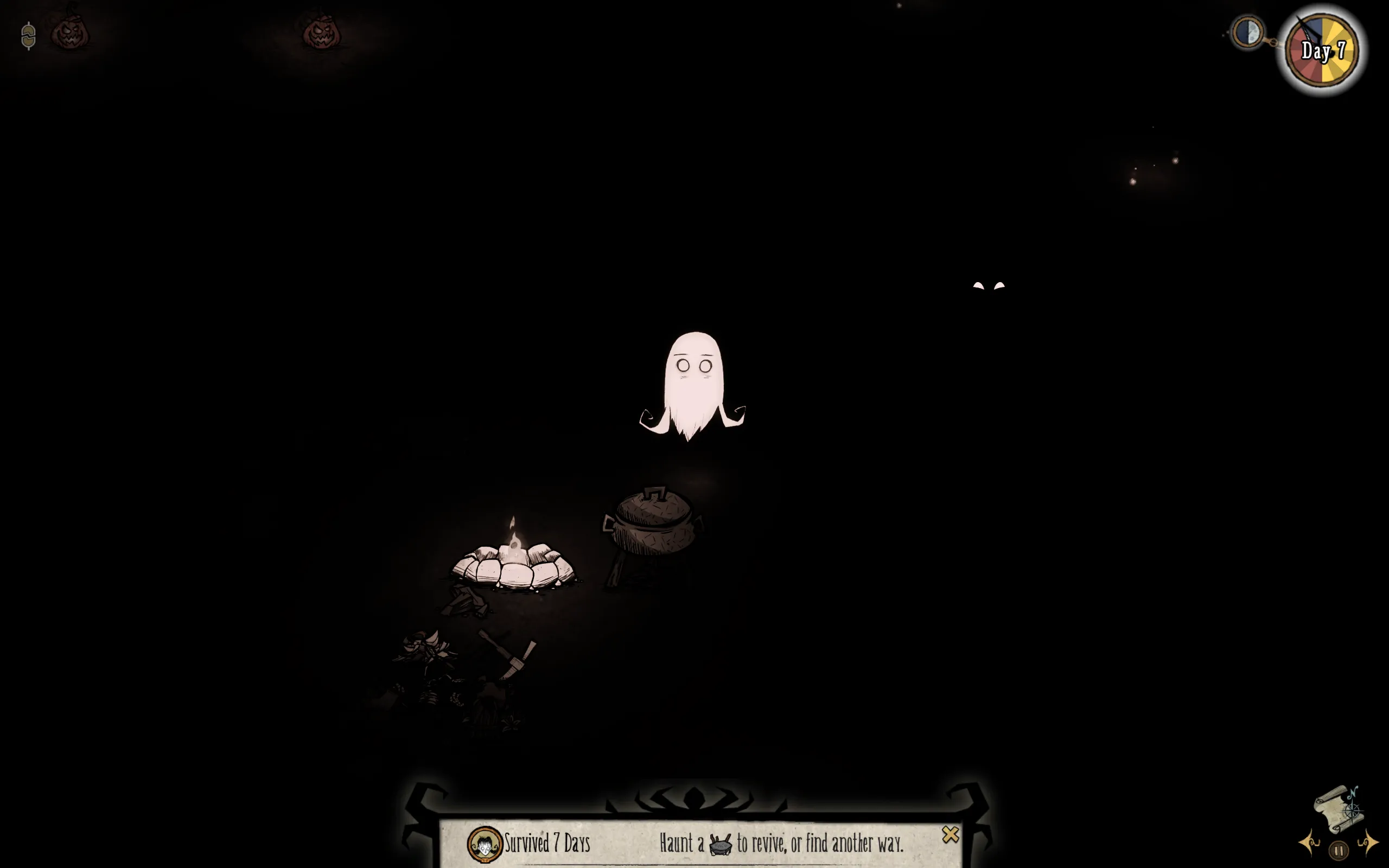 "Wait, you died again?"
There is a phenomenon in co-operative board games known as “quarterbacking.” Quarterbacking is the tendency in games for one, generally - but not always - more experienced player to take control of the game, telling other players what to do, how to do it, and when, but never why. There is no why, just the myopic desire to win. It can, at times, be helpful to have a more experienced player at the table to teach the game and help new players understand how to play. In games like Battlestar Galactica or Dead of Winter, I often am that player, explaining complex mechanics and the pros and cons of decisions, but leaving the decision of what to do up to the group. The difference between the experienced player and the quarterback is in that sense of agency. A quarterback doesn’t leave decisions up to the table, but instead, makes decisions on behalf of the group. This remains true, even if the quarterback is not the most experienced person at the table, or even that good at the game. They want to be in control for their own nebulous reasons and will trample every other player’s agency to get there.
Any time I’m at a table with a quarterback, I lose interest not only in the game, but the table as a whole. I’m at these events to be a participant, to learn and have fun alongside everyone else and not be an NPC in someone else’s game. If there’s someone at the table who places victory in a board game over the enjoyment and participation of everyone at the table, it sends the message that this is not a group where I as an individual will be respected.
I’ve encountered a lot of these tables. Any time I move to a new place, I usually have to hunt around for a board games group because of the prevalence of quarterbacks who don’t see me as an equal participant, however inexperienced I may be. Without being allowed to participate, there’s not a way for me to gain that experience, so why bother? Why bother with the game, the group, any of it?
It’s isolating, and it sends a message about how I’m viewed and who I am. Regardless of the game or how good I am - and, to be clear, I am very good at board games - I cease to be any of that in groups with a quarterback.
Instead, I am The Girlfriend. I am playing The Girlfriend’s Character. What The Girlfriend does doesn’t matter, because she’s The Girlfriend. She’ll be gone soon enough, and then the actual gameplay can begin.
 This is me, and I will utterly demolish you at Power Grid.
Co-op video games lend themselves well to quarterbacking. Setting aside any experiential gap, video games often include a time pressure or lend themselves to repeating a tried and true strategy. This is especially true of survival crafting games, where a particular strategy repeats over the course of multiple games in the genre to the point where it’s second nature to veteran players. When paired with an immediate time pressure to survive, this creates an incentive for players to leap into action from the start, running through the strategies that have kept them alive in the past and trawling down memorised routes. There is very little space for someone else in these strategies, leaving that friend standing there, holding a stick and wondering where everyone else ran off to.
When I play survival crafting games on my own, I’m not bad at them. I understand the conventions of the genre, and while they don’t interest me, it’s not because I have no skill at them. I understand the concept of slowly building, piling up resources to build bigger and better things. I know what I’m doing.
Quarterbacks, though, don’t care that I know what I’m doing in the genre as a whole. A quarterback only cares if I know the particular strategy that’s being enacted at that moment, and, even more importantly, whether I’m going to agree with them or be dead weight. Co-op video games lend themselves well to quarterbacking, but none moreso than survival crafting, with its arcane recipes and immediate need to survive.
I understand how to play. I don’t play the same way as Jeff, so I get left behind.
Any time I load up a survival crafting game, I’m reminded of Jeff. I’m reminded that it doesn’t matter how many of these I play, how much time I spend on them, I will never have the same formula he does, and I will always be left behind.
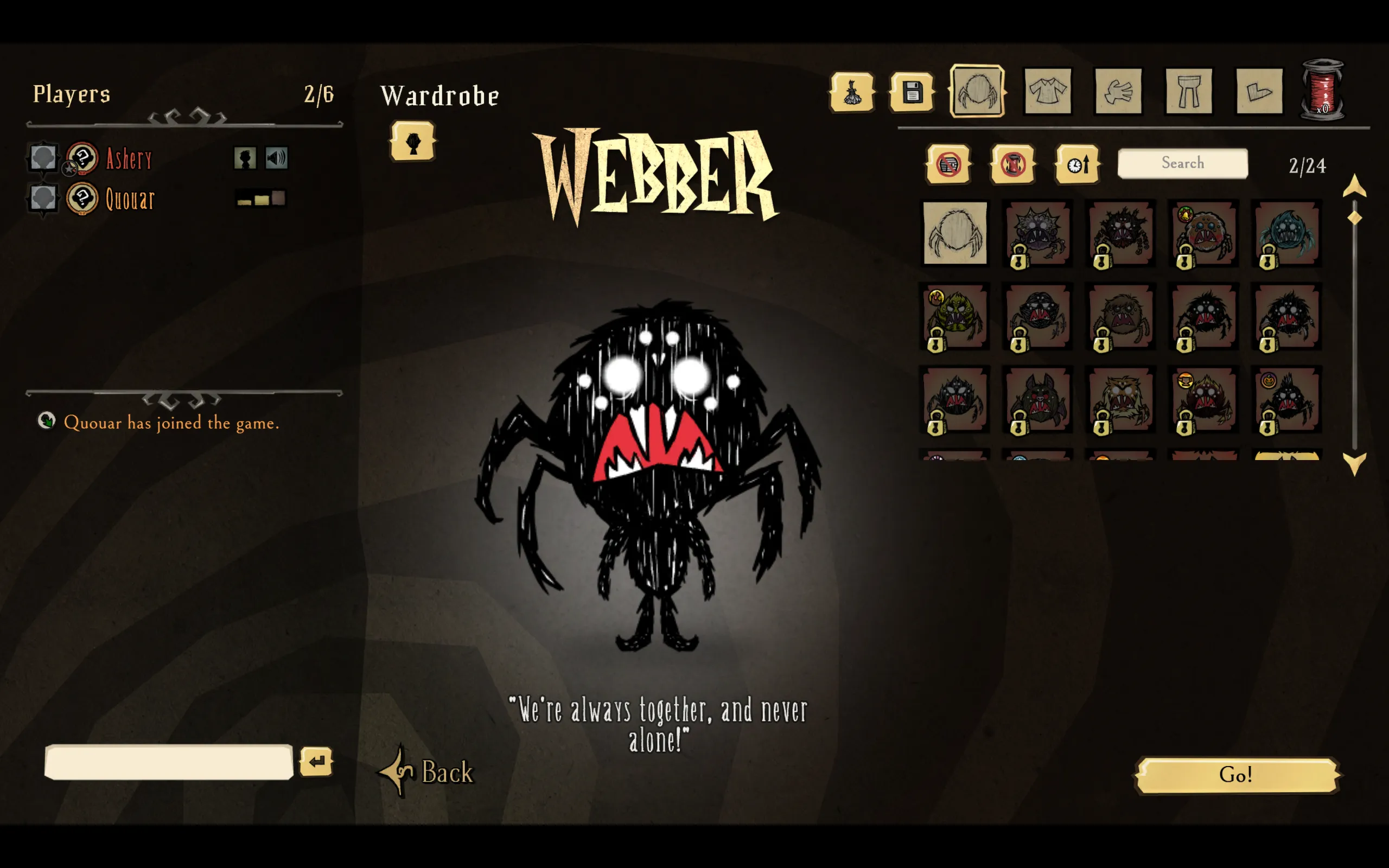 spider must scream
This isn’t survival crafting as a genre’s fault. It’s no one’s fault, really. People are who they are, and while many of the quarterbacks I’ve had the misfortune to play with have been so due to some latent misogyny or assumption that I didn’t belong in Their Space, that’s not the case with Jeff. Jeff knows what he’s doing, and so he’ll do it, because it’s what brings him joy.
But when the only experience I have in a space is that I’m not good enough, and never will be, why would I keep coming back to the table?
I don’t have a review of Don’t Starve Together. I never will. I can’t give it the time it deserves because it requires co-operative play, which means my only option to play it is to be quarterbacked.
And I’d rather not. I’ll stick instead with the games where I get to play too.