
dotAGE Review
This is still not a review of a survival game because all the survival games in my library deserve a better reviewer than me. If anything, this is a sequel to the review of Don’t Starve Together, less a review, and more an exploration of why I bounce off these games so hard. It’s not enough to say “I don’t like this.” It’s not enough to say that they require a physical component I don’t find fun. There is something at this point deeply fundamental about my dislike of survival crafting games that is verging on hatred which, given the prevalence of these games and the increasing incorporation of survival crafting mechanics into other genres, feels deeply unfair.
But there is a reason. There’s always a reason.
To which I’ll start with a chicken.
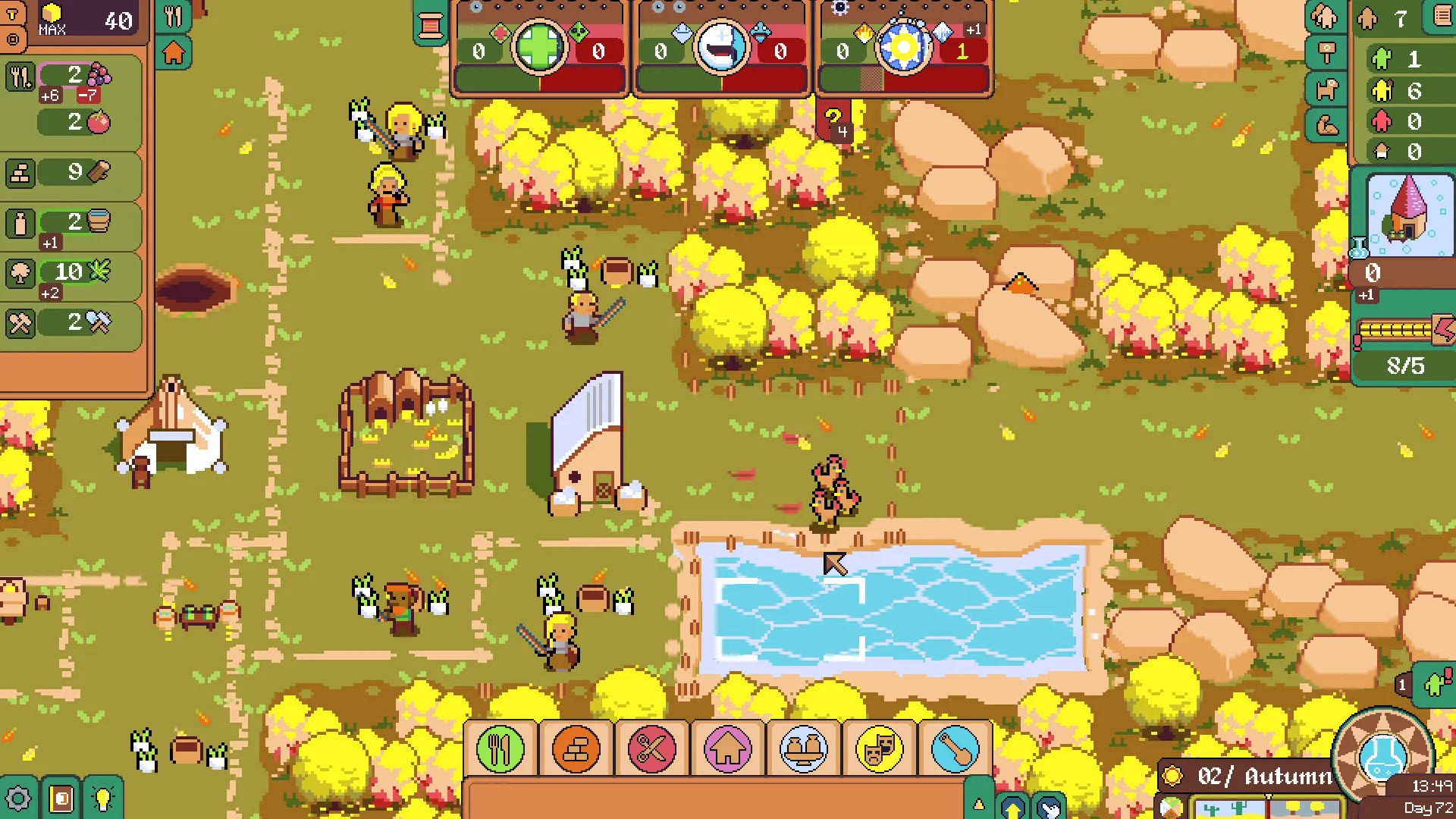 Hello chickens
dotAGE is a survival roguelite citybuilder. You build a village, guide it through a series of crises, gather resources, and tend to your village.
That’s not the point. I am not here to explain citybuilders to you. I am not here to explain roguelite citybuilders to you. You are reading my reviews. You know what a citybuilder is at this point. Nothing about dotAGE is the point, because this isn’t about dotAGE. It’s about the chicken.
As part of the mechanics of dotAGE, the little town needs to have sufficient resources to feed its population and survive the long winter. My town spawned next to a flock of chickens and I, fool that I am, saw an opportunity. Chickens lay eggs. Eggs are food. I could use the chickens to get food.
I built a chicken coop. After building the chicken coop, I tried to put the chickens in the chicken coop, at which point, the game asked “do you have seeds for the chickens?” I gathered seeds, then popped chickens into my coop. “Ah,” said the game. “But do you have a chicken farm?” I built a chicken farm, then stared at my chickens, waiting for them to make me breakfast. “Wait,” said the game. “Do you have a chicken minder to harvest the eggs from the chicken farm?” I assigned a chicken minder to the chicken farm. “Sure,” said the game. “But does your chicken minder have the appropriate tools for harvesting eggs from chickens?”
At which point the entire village starved because of the amount of time and energy I’d invested in trying to get eggs from chickens.
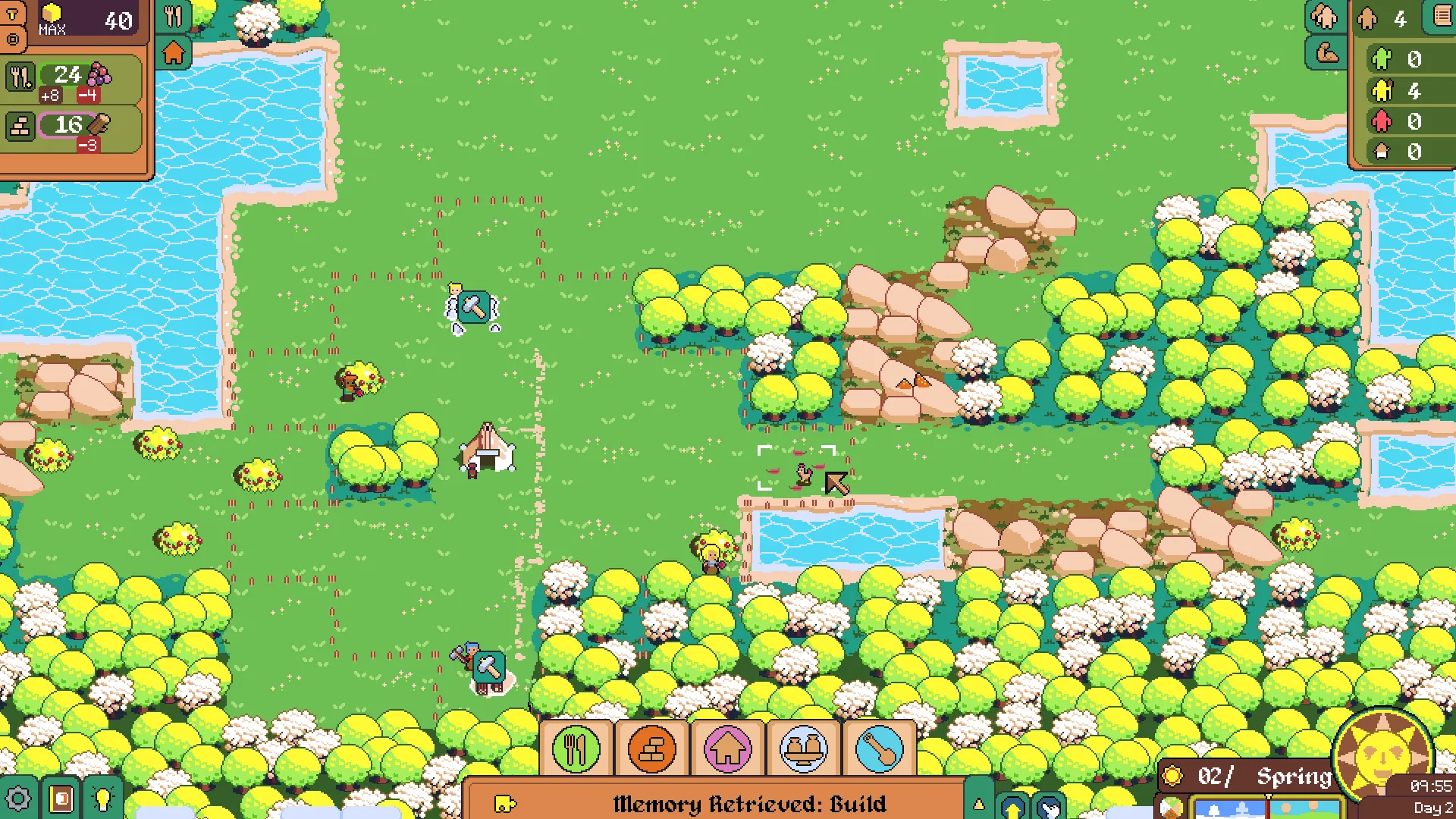 Did you know chickens were domesticated at least 8000 years ago, and that it required no specialised tools or chicken farms?
Part of the appeal of building games is the knowledge that my imagination is the limit. Even in games with intricate resource systems and the knowledge that I will have to source the resources to make my dreams come true, my dreams can still be dreams. I can still look at a blank map and envision where everything I build will go, even if I know there will be some variation along the way. In an ideal situation, the game provides me with the knowledge I need to understand the challenge before me, plan for it, and build what I would like to build.
dotAGE doesn’t do this, partly by design, and partly by the nature of the genre it’s in. I won’t fault it for either - this is, again, not a review, and none of this is dotAGE’s fault - but it is to say that that opacity makes building in a satisfying way impossible. I am presented with a map, yes, but what tools I have available are masked and always will be unless and until I take resources from other projects to figure out what I have to work with. It’s not until I’ve invested in the chicken coop that I can see the next step, and even then, I don’t know and can’t imagine how many steps are left, because my sense of what makes sense has no bearing on reality.
This masking of requirements isn’t unique to dotAGE. It’s typical of the survival crafting genre as a whole, where what tools are available only becomes clear with the building of earlier and lesser technologies. Bad survival crafting games take this mechanic and force players to waste resources on crafting a minimum number of useless items before they’ll reveal other options. dotAGE instead hides what resources will be needed and if the map even has the applicable resources, making planning an act of futility.
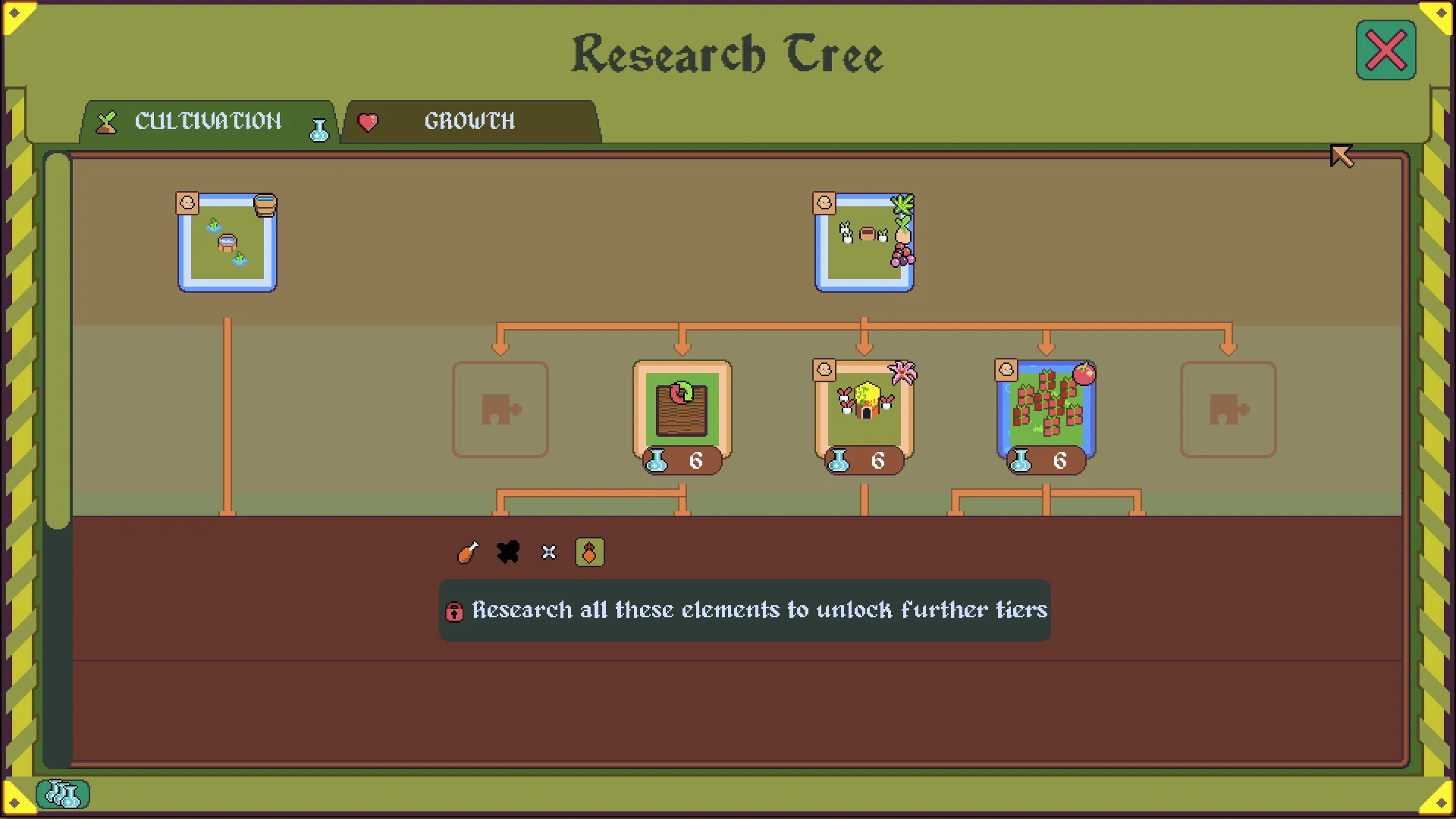 Do I know what any of these are? Does it matter?
The answer, of course, was explained to me. The icons in the research tree explain what tools I’ll need for each building or what each building produces. Everything in the game is very transparent, and nothing comes out of left field. It’s on me, all on me, to not know everything intuitively, or to not know how everything works from the moment the game is loaded. It’s on me for not having done the reading beforehand to know the optimal play. It’s on me.
I’ll grant you, games do not need to hold the player’s hand. They do not need to cater and condescend, explaining every minute detail until strategy turns to mush. But when planning is hidden behind progress bars, and each step leads to another in and endless cycle, that desire to pierce the veil and understand what lies behind that opacity is non-existent.
I’m not asking to be spoonfed, but I would at least like a spoon without having to uproot half the map trying to figure out how to make one.
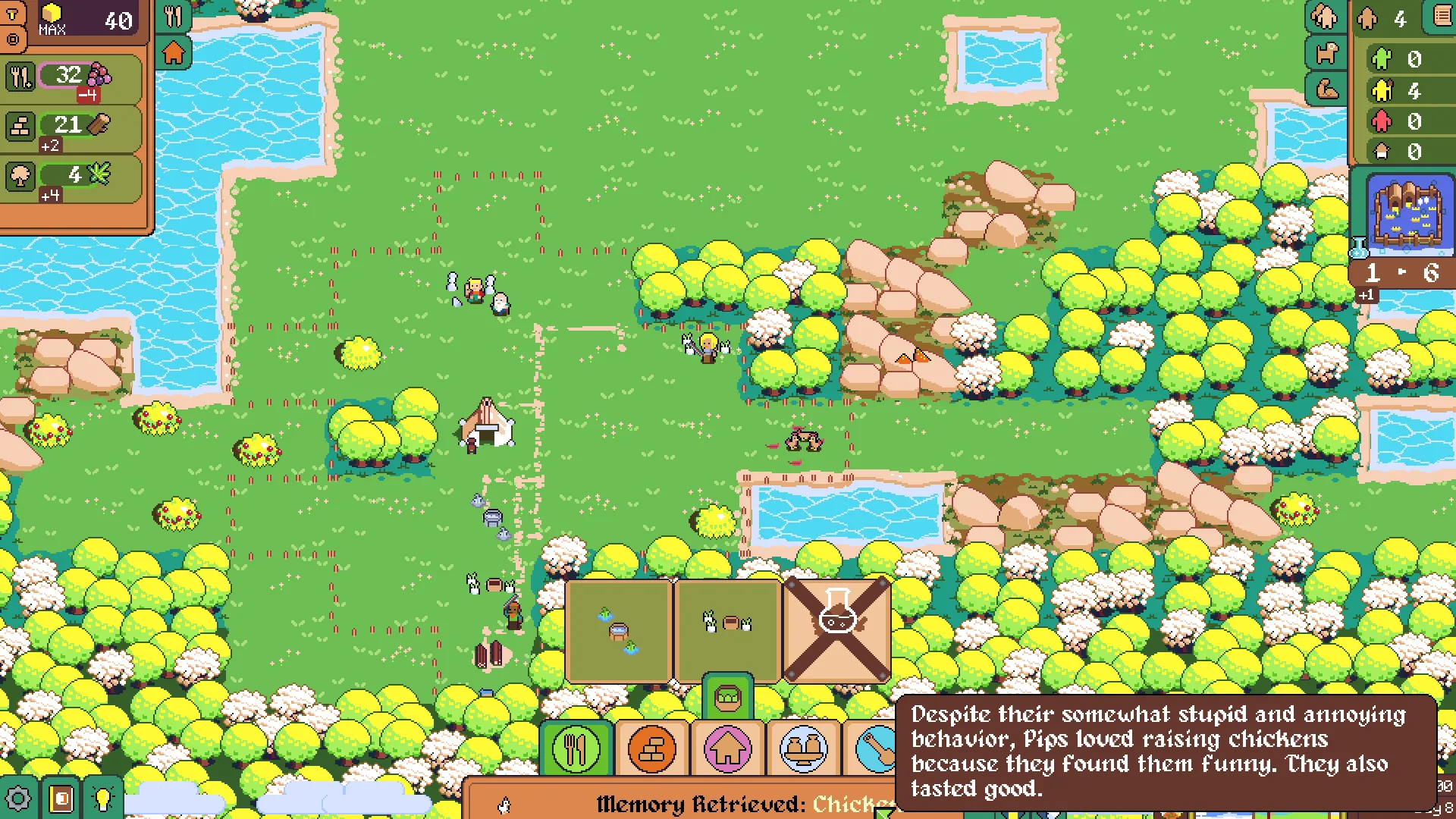 I, too, enjoy chickens.
There are a wealth of builder games I enjoy that include an intricate resource system. Rimworld is perhaps the best example, with its survival elements intertwined with base design and a bivvy of random events. Against the Storm is one of my favourite games, and it is very much a survival city builder, though with a focus on logistics rather than pure survival. Even Stardew Valley, dark horse example though it may be, has crafting elements at its heart, with players gathering resources to build and buy new elements for their growing farms.
The difference, though, is that there is transparency. In Rimworld, I can see the tech tree from the start, have an idea of what I’m building towards, and plan accordingly. In Against the Storm, though randomness gives me a range of possible buildings and design pathways, I know what resources I need for any given project because it’s listed from the outset. There are no nested requirements, no inscrutable and impossible to predict needs that can crash an entire run because I was unaware they existed. In Stardew Valley, even if I don’t know from the outset what resource I’ll need when, there is a clear and predictable path and an intuitive idea of what makes sense to need. The buckets to gather milk are sold in the same place as the cow. The swords are sold outside the first dungeon. It makes intuitive sense.
Survival crafting is not about intuitive sense. It isn’t about transparent or reasonable pathways. It’s about arcane formulas and nested, unpredictable requirements that only make sense if this is your hundredth hour in your tenth survival crafting, and you know this genre like you know the contours of the machine on which you’re playing. It makes sense if you’ve done the reading, and if you haven’t, that’s on you for being moronic enough to believe that if you loaded a game, it would make sense as you played it.
And maybe I am that moron. Maybe I am too stupid to understand.
So instead, I’ll just simmer in my intense dislike and shut out the entire genre for it.