

The Centennial Case: A Shijima Story Review
I love mysteries. I like the challenge of picking up disparate pieces and sliding them into place, watching as they turn from nothing into something using only the power of thought. It’s satisfying, and it makes me feel like a clever little cookie every time.
One element of mysteries, though, is that, while the mystery itself needs to be compelling, the means by which a detective is asked to solve it has to be reasonable and engaging. This can be through physical examination of the clues, a la the ABC Murders. It can be through deduction and letting the player tease through different potential solutions until one fits, a la the Case of the Golden Idol. When it becomes tedious and a case of the player having to spend more time understanding what the game is trying to say than actually engaging with the mystery, though, a mystery game loses the plot, and instead becomes a case of a failed execution, however compelling its underlying mystery may be.
The Centennial Case: A Shijima Story is a chore to struggle through, and no amount of story can save that its mechanics are tedious, annoying, and distract from the fundamental joy of a game of deduction.
 This is basically how my brain works, though.
The Centennial Case: A Shijima Story is an FMV mystery game. You play as Haruka Kagami, a mystery writer now thrust into the role of a detective, solving murders surrounding the enigmatic Shijima family and uncovering the truth around the fabled fruit of youth.
As an FMV, each of the events is portrayed through a live cast of actors. The player watches what is, essentially, a film with very little gameplay beyond noting the clues that the game helpfully labels as clues when they appear. These film sections are well shot and directed, and, as films, work perfectly well. While the tropes of Japanese filmmaking and storytelling aren’t my favourite, that this particular story and its tropes weren’t my cup of tea isn’t a slight on the FMV sections themselves. Rather, it’s to say that this game is likely more compelling for someone who prefers Japanese media, and that I am not that person.
After each FMV section, though, the player is thrust into the heart of any mystery - the deduction. Having observed the mystery, the player is then challenged to solve it using all the various clues they’ve observed.
This is the crux of any mystery game, the entire reason people play the genre. And in Centennial Case, this element is an absolute failure.
 Oh my god, I am a GENIUS.
Take, for instance, the mechanics of solving the mystery. Players are presented with a “deduction space,” an area separate from the FMV populated with questions, clues, and the opportunity to rewatch segments of the previous FMV section. These questions can be things like “What was in the jug?” or “Where did the victim die,” questions that are perfectly reasonable questions to ask in any murder mystery. Players then place clues around each question, forming hypotheses based on the clues they associate with each question. A mention of pesticide, for example, might help elucidate what was in the jug, or a bloody pool where the victim died.
This is, in theory, a reasonable way to design a mystery game. This approach allows players to use logic and to decide for themselves what’s relevant to solving the case, and which clues are red herrings. It allows for the exercise of creativity, deduction, and logic.
Or it would, if that’s how the system worked.
Instead of allowing players the freedom to associate clues and use logic, Centennial Case has a set list of clues belonging to each question, with the logic behind each association sometimes being esoteric and unfathomable. This leads the game to cease to be a logic puzzle, and instead become a tedious task of dragging clues into a question until something populates, however nonsensical it may be.
Rather than allowing players to use their own reasoning skills, the game instead forces them to engage with the game’s logic, adding bumpers to a logic game to guide less astute players, and completely shutting out veterans of the genre. There is no mystery to solve here, beyond the baffling mystery of why a mystery game would be designed without the ability to engage in the actual act of solving a mystery. The ultimate outcome is a film broken up by deeply tedious rote actions to reach an absolute moon logic solution.
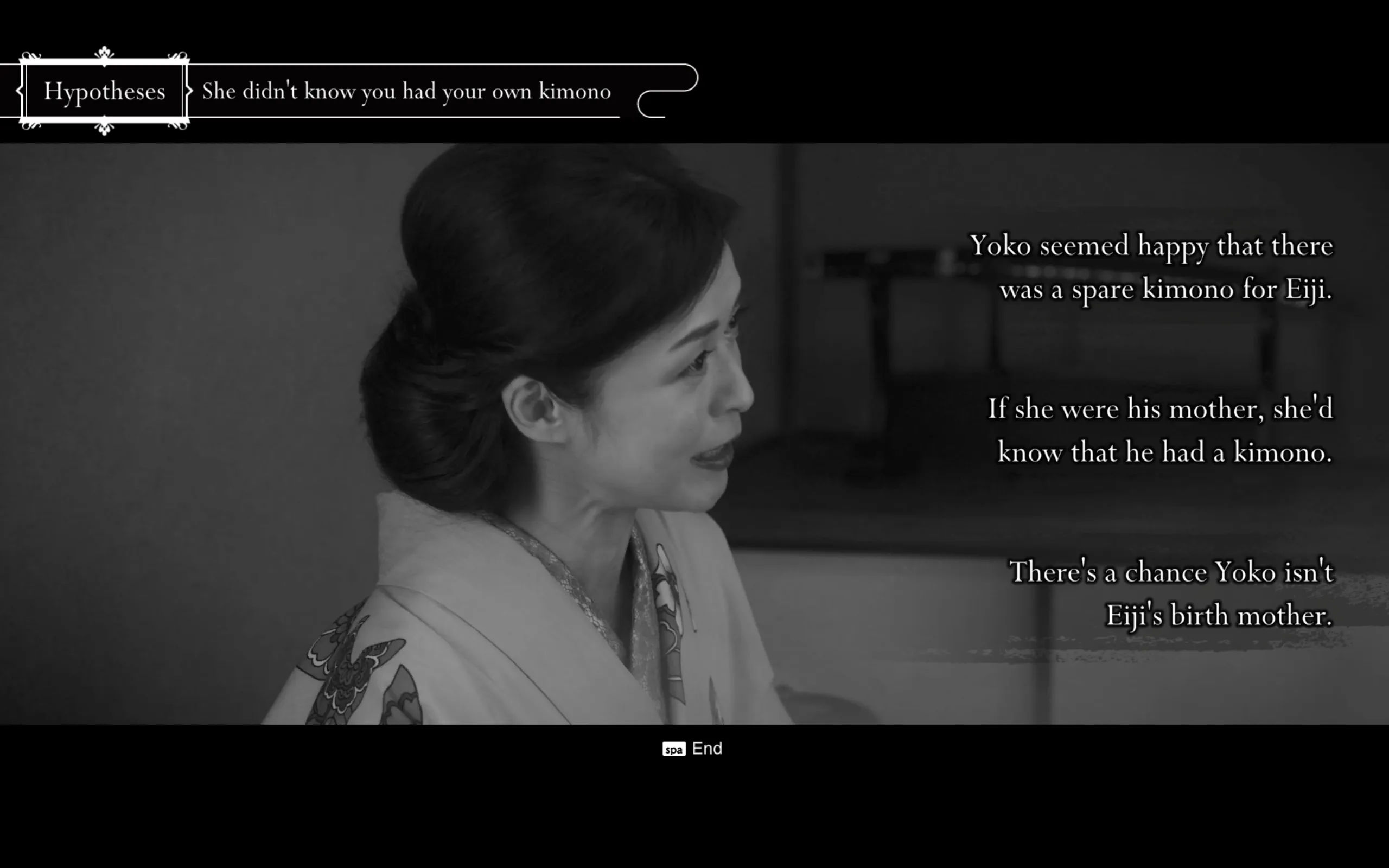 "Logic"
Centennial Case: A Shijima Story is a fascinating case of a game fundamentally not understanding its genre. There is plenty of room for an FMV in the mystery genre; indeed, it might offer a fresh method by which players could engage their deductive juices. Centennial Case, however, isn’t it. By flashing a big notice to players about clues, and by holding their hands through a tedious “deduction” section, it drains all fun out of solving a mystery. This game isn’t about solving a mystery - it’s about watching a film, doing a chore, and then watching the film plod along once more.
The only mystery to be found here is why the game is designed to remove anything that makes a mystery compelling, and I for one, am not particularly interested in solving it.
Developer: Square Enix
Genre: FMV, Mystery
Year: 2022
Country: Japan
Language: Japanese (with English subtitles and text)
Time to complete: 13-15 hours
Playthrough: https://youtu.be/mumTcOY8g9Y