

Vegan Pumpkin Coconut Soup
Ingredients
1 pumpkin, cut into chunks
1 can coconut milk
3 cups (720ml) vegetable broth
3 tbsp ground ginger
Chives for garnish
Salt
Pepper
Instructions
- Add pumpkin, ginger, and vegetable broth into a large pot. Bring the broth to a boil, then let simmer until the pumpkin is soft (~10-15 minutes).
- Blend the pumpkin in a food processor until smooth. Add coconut milk, and stir to combine.
A longer and more detailed description
Of all the various regions this series has covered, I think the Pacific Islands are the most difficult. The combination of specific ingredients with cooking techniques that I can’t replicate means that I can’t quite capture the flavours and styles of the Pacific Islands.
This will not, however, stop me from trying, especially when I intentionally pick a recipe so easy, it’s impossible to botch.
The hardest and most time-consuming part of this recipe is chunking up a pumpkin. Give yourself at least twenty minutes to stare at your pumpkin, your tiny cutting knife, and the pumpkin again. Plunge the knife into the pumpkin, put some muscle into it, and really work at separating the shell from the fleshy, fleshy inside. You are vegan, and let’s be honest, this is the closest either of us will ever come to feeling like we have hunted and killed our quarry. We will earn this pumpkin, and it will be worth it. It will take some time to hack away at it, but eventually, you’ll manage to turn a pumpkin into food.
Once you’ve de-shelled the pumpkin, chuck it, the vegetable broth, and the ginger in a pot. Bring it to a boil, then lower to a simmer while you wander off to bask in your accomplishment. Don’t wander too far or for too long, though - once the pumpkin is soft, you’ll need to blend it into a puree. It’s not enough for the pumpkin to be de-shelled. It must be rendered into something utterly unidentifiable as a pumpkin, recognisable only by virtue of being orange. Blend it, then add the coconut milk, salt, pepper, and chives, and give it all a mixy mix. Bon kangae ko raoi!
Substitutions and suggestions
For the pumpkin: Fine. If you want to take all the effort out of this dish, you can substitute the pumpkin for either sweet potato or butternut.
What I changed to make it vegan
I made this as simple as possible for myself and picked a dish that was already naturally vegan.
What to listen to while you make this
I had a lovely time just vibing to Toka-n-Tarawa.
A bit more context for this dish
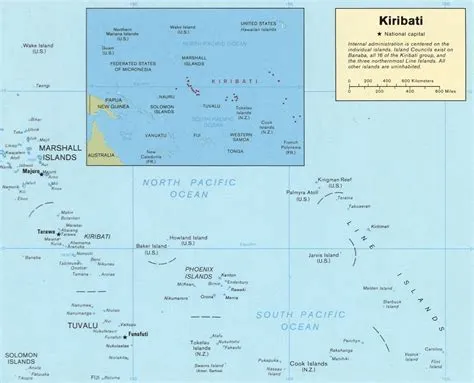
I-Kiribati cuisine, like the cuisines of most Pacific Island nations, is highly dependent on what can be found on Kiribati’s thirty-two atolls and one island. As such, its cuisine is highly dependent on coconuts and seafood, with rice being introduced as a new staple after WWII. Pumpkin, too, is an introduced crop, though its introduction to the islands from the Americas is a bit more circuitous, as is the introduction of the sweet potato. Both, however, added valuable nutrients to a diet traditionally starved for carbohydrates.
Much like this dish, Kiribati itself is a constructed nation, comprised not necessarily of natural boundaries or even a shared identity, but rather, the result of European colonisers splashing lines on a map and calling it a day. That Kiribati is a created place, though, doesn’t change its sense of identity and what it has become since its independence in 1979.
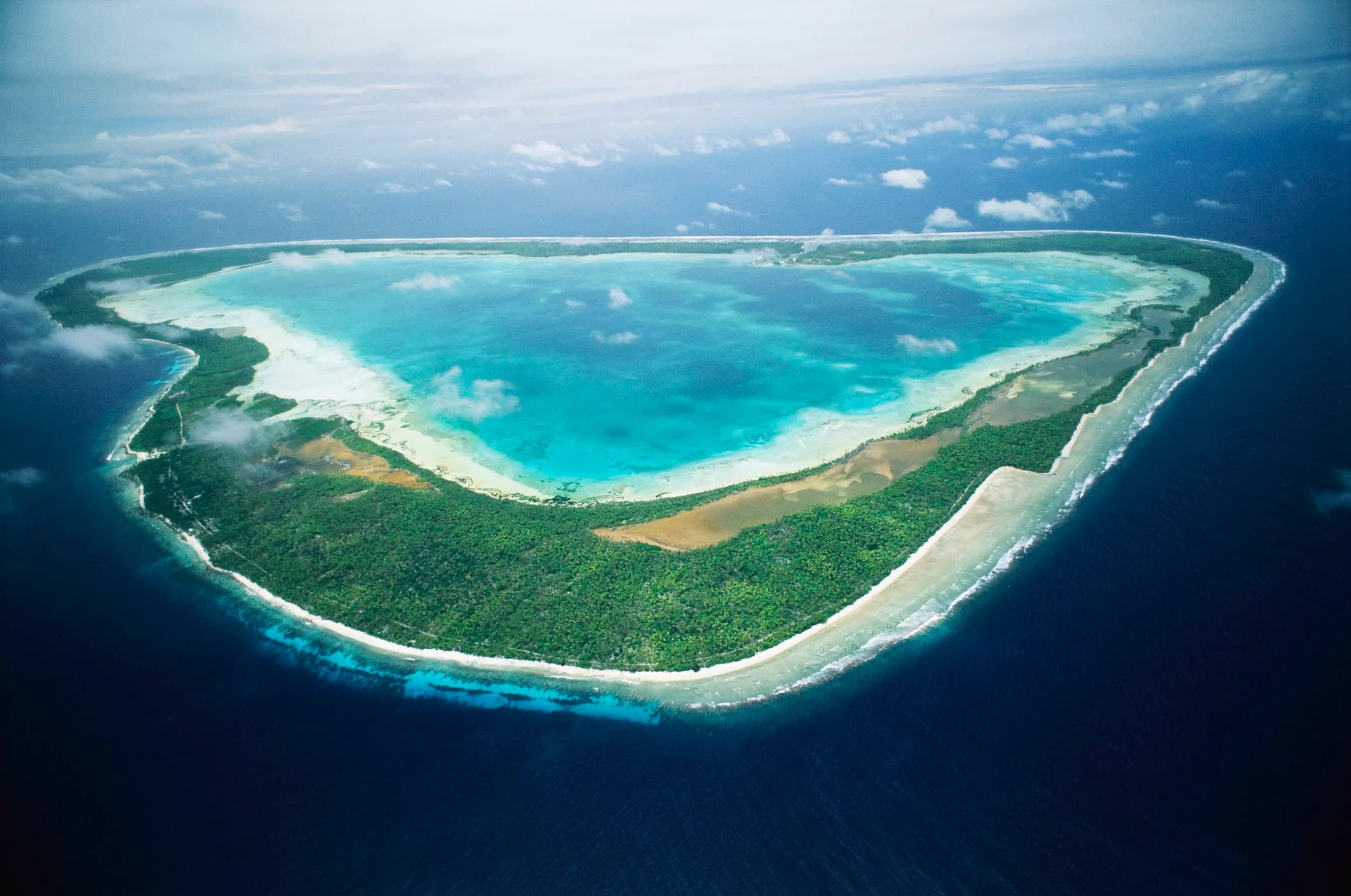 Marakei Atoll (Source: Getty Images)
Kiribati consists of several sets of archipelagos, namely, the Gilbert Islands, the Line Islands, and the Phoenix Islands, each of whom were not only politically distinct from one another prior to colonisation, but also comprising of islands politically independent of one another. This jamming together of multiple archipelagos in one nation is part of why Kiribati has the geographical peculiarities it does. Kiribati stretches across three timezones, and despite parts of it being further east than Hawaii, has the earliest timezone on Earth.
The name “Kiribati” itself is also a reflection of a colonial history, with “Kiribati” being the Gilbertese pronunciation of “Gilberts,” the name given to the country’s main archipelago by Russian and French explorers in 1820. However, “Kiribati” is also a reflection of the identity the country has chosen for itself, eschewing the indigenous name of the Gilbert Islands - Tungaru - in favour of the name Kiribati, reflecting the country’s identity beyond just the Gilbert Islands.
Kiribati’s colonial history is also one of mixed influences, with the islands now making up Kiribati being initially divided between the British and Germans, then the British and Americans, then the Japanese, before finally being united by the Treaty of Tarawa. The native I-Kiribati were, like many Pacific Islanders, subjected to forced labour, forced resettlement, and the devastation of their natural environment by American nuclear testing, but chose, time and time again, to be a unified entity in the face of external pressure and persecution. It was Gilbertese uea who agreed to become a British protectorate, doing so to protect their people from further European encroachment. It was President Teburoro Tito who moved the international date line to make Kiribati united in time zone and create a sense of shared identity.
And it is the I-Kiribati who are determined to maintain the identity of their people and their nation, even as Kiribati becomes the first nation to disappear entirely due to the effects of climate change.
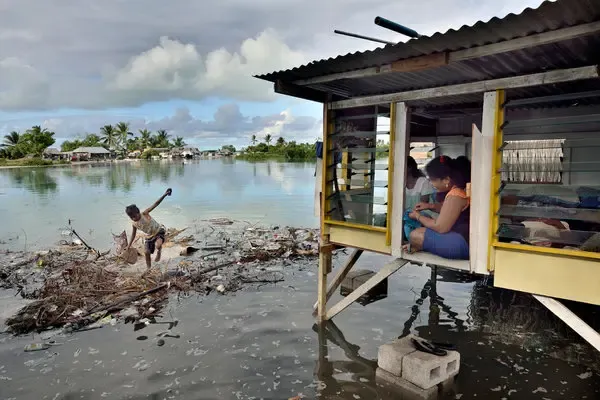 Flooding in Kiribati due to rising sea levels (Source: New York Times)
Climate change, though it is a global threat, is a particularly acute threat for Pacific Island nations. Most nations lie only a metre or two above sea level, with most of their populations living within two kilometres of the sea. When typhoons or tsunamis hit these islands, the devastation is total, with islands taking months to recover. Their reliance on the sea for their livelihoods means that rising ocean acidification leads to food shortages. Crop fields become more and more salinated, leading again to food and water shortages and social instability.
Kiribati, as a nation consisting almost entirely of atolls, is the first nation that will slip into the sea. There is, at this point, no stopping it - by 2050, 75% of the country will be vulnerable to inundation. 95% of the population has already suffered climate disasters, and 77% of the population agrees that the only solution is to leave. Many on the islands are already doing exactly that, fleeing to places like New Zealand and Australia, only to find that, upon arriving there, it can be hard to find a place in a larger, unfamiliar country. While I-Kiribati try to maintain their culture and traditions in places like New Zealand, in the face of increasingly anti-immigration governments, being able to leave Kiribati and forge a new life somewhere else is becoming more and more impossible.
The consequences of climate change will affect us all, but it is those who are most vulnerable and who have contributed the least who nonetheless suffer the bulk of the consequences.
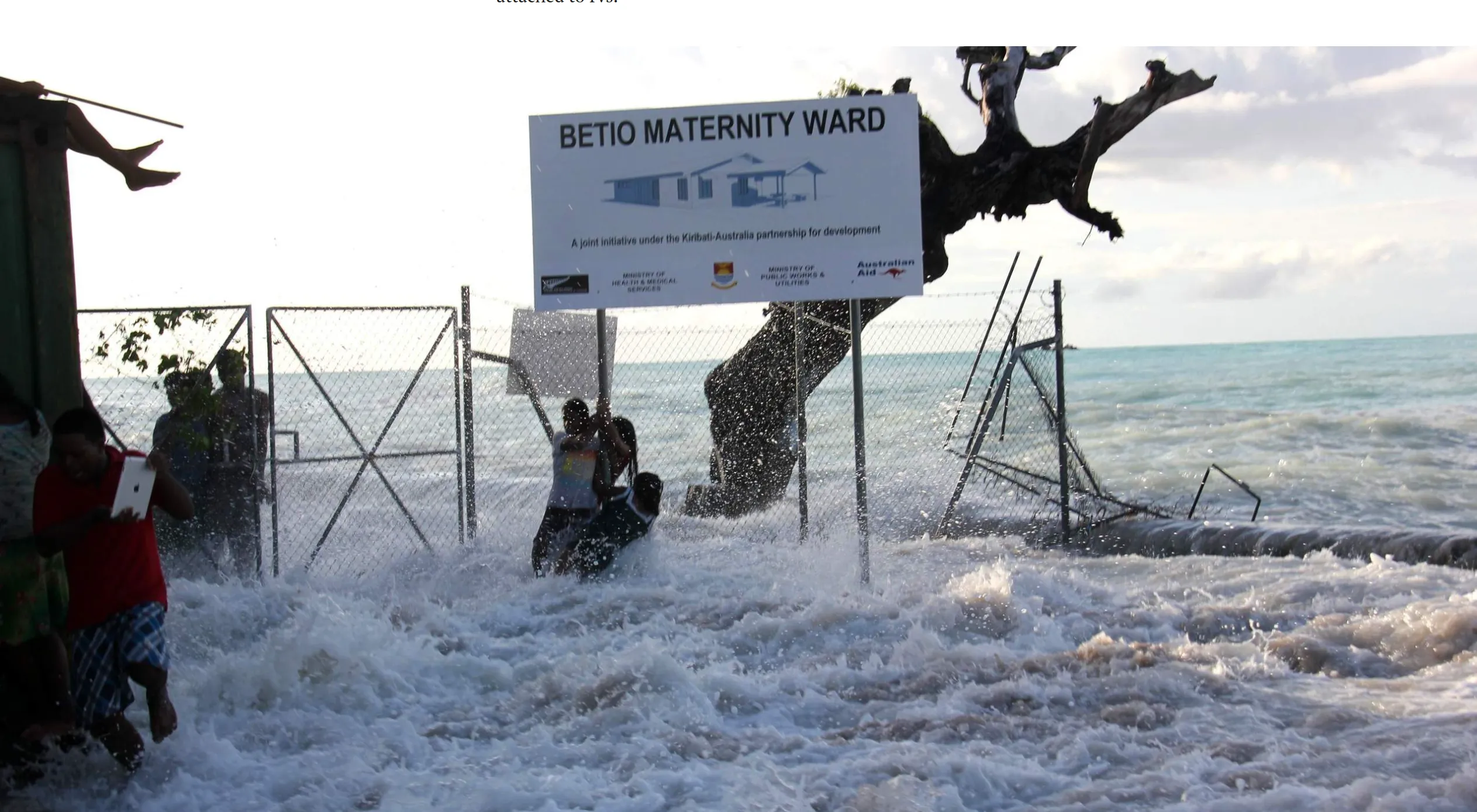 Flooding at a maternity ward (Source: Stuff.co.nz)
What, then, is a nation when its land slips into oblivion? What is the future of Kiribati and the I-Kiribati? Kiribati is itself a crafted nation, built from lines slapped on a map and nonetheless, creating an identity of its own. When the land is lost, though, and the people dispersed, what happens to identity? What happens to those left far from their homeland that no longer exists?
I don’t have an answer, other than to say that Kiribati is not alone, that the I-Kiribati are not the only ones left to face the consequences of a crisis they did not create. The very least the rest of us could do is recognise what stands to be lost, and do what we can to support those who remain.